

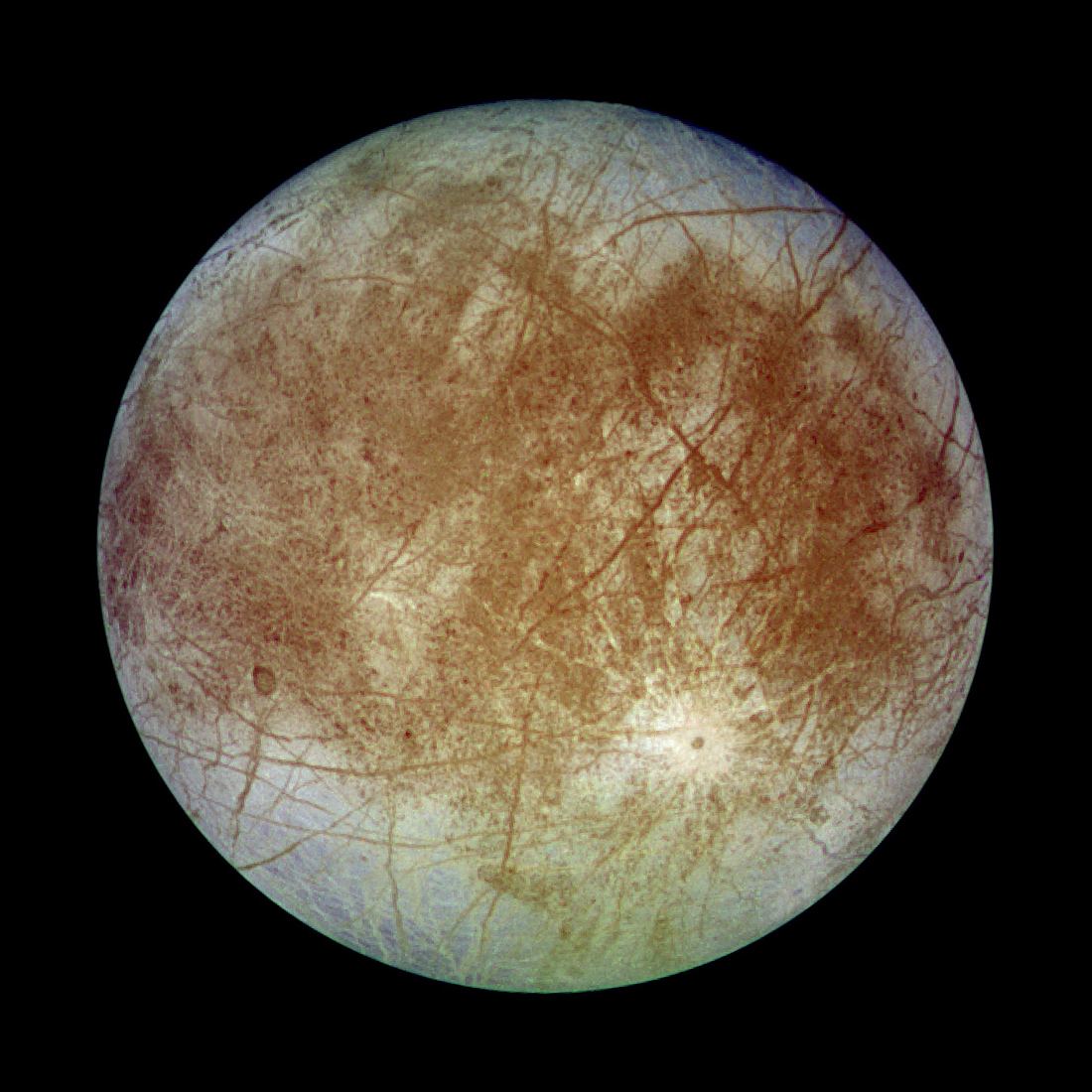
Europa, the icy moon of Jupiter, is one of the most compelling places to search for the conditions of life, with a deep ocean believed to lie beneath its frozen crust. It is also one of the harshest radiation environments in the solar system. Jupiter’s powerful magnetic field traps charged particles and hurls them at Europa’s surface continuously, delivering doses that would rapidly degrade electronics, alter surface chemistry and complicate any attempt to detect delicate organic molecules. Scientists designing future landers are now using detailed radiation maps, built from spacecraft measurements and modelling, to identify where on the surface exposure is lowest and how deeply instruments would need to be shielded or buried to survive. The maps reveal a patchy landscape of risk, shaped by the moon’s rotation and its interaction with Jupiter’s magnetosphere, meaning the choice of landing site could matter as much to a mission’s lifespan as the design of the spacecraft itself and its protective vault. Landing site shortlists are already being revised in light of the newest exposure estimates available.
What the Evidence Shows
Radiation is not purely an obstacle, because it also drives chemistry on Europa’s surface, creating oxidants and other compounds that may eventually cycle into the ocean below and provide energy for possible ecosystems. Sampling strategies therefore face a trade-off: the most chemically interesting surface material may also be the most radiation-processed, potentially destroying the very biosignatures a lander hopes to find, while fresher material excavated from below the surface by geological activity could preserve them better. Engineers are testing radiation-hardened electronics, shielded vaults and instruments designed to dig or melt a short distance into the ice to reach cleaner samples. Mission studies increasingly assume a working life measured in weeks rather than years for surface operations, with the spacecraft completing its most important measurements early. These constraints are shaping a realistic path forward: Europa can be explored, but only by missions designed from the outset to respect an environment far more hostile than its serene, cracked ice appears from a distance. Reporting and analysis from sources such as NASA track the same developments, and specialists following the intense radiation at Europa say the direction is now consistent across independent lines of evidence.
The Wider Context
Funding bodies are watching the intense radiation at Europa closely because the work sits at the junction of basic curiosity and practical return. Grant panels increasingly ask for a path from discovery to application, while researchers push back that the most valuable uses of fundamental science are rarely the ones written into the original proposal. The tension is productive when both sides stay honest about timescales.
What Happens Next
The long view on the intense radiation at Europa is that fields advance by accumulation rather than by single announcements. This result adds a solid, checkable piece to a structure many teams are building, and its authors have shared their data so the piece can be tested from every side. That is how the picture eventually becomes reliable enough to act on. You can follow related developments in our coverage of science.
It is also worth remembering how quickly the picture in this area has changed before. Positions that looked settled a few years ago have been revised as new data arrived, and the same humility is appropriate now. The strongest coverage of this subject, and the most useful advice, tends to come from sources that update their views openly when the facts move, rather than defending an earlier position long after it has stopped fitting the evidence available.
