

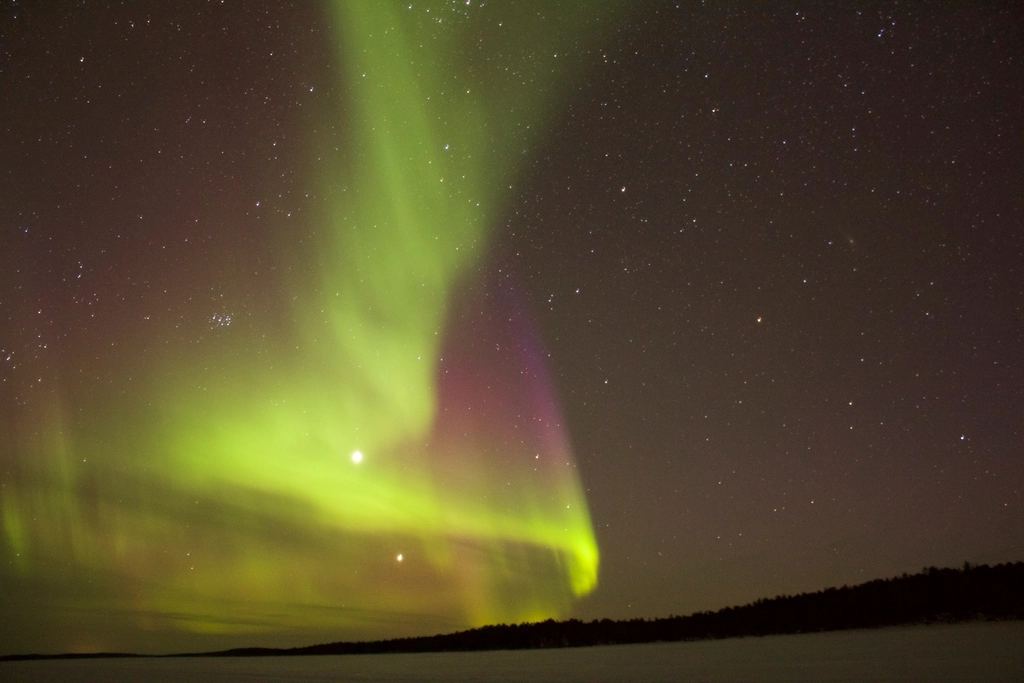
NOAA’s Space Weather Prediction Center forecasts minor geomagnetic storm conditions, G1 on its five-step scale, on November 27 and 28, 2026, as a fast stream of solar wind from a coronal hole reaches Earth. The stream is expected to arrive around November 27, pushing the planetary K-index to 5 and expanding the auroral oval so the northern lights may be visible at high latitudes, including northern Michigan and Maine. The forecast, issued on November 9, also flags G1 conditions on December 4 and 5, and coronal holes can recur on the Sun’s roughly 27-day rotation, returning the same stream again and again.
What the Evidence Shows
The same coronal hole already stirred Earth’s magnetic field earlier in November, driving a G1 storm late on November 7 that pushed the Kp index to 5.33, with solar wind peaking at 706 kilometres per second on November 10, far above the typical 400. At G1 levels NOAA warns of weak power-grid fluctuations and minor effects on satellite operations, and the electron flux at geosynchronous orbit crossed its alert threshold on November 8. A G1 storm is the weakest level on the scale, so skywatchers should expect bright displays at high latitudes rather than the all-sky shows a major G4 or G5 storm can bring. Reporting and analysis from sources such as NASA track the same developments, and specialists following November solar storm aurora say the direction is now consistent across independent lines of evidence.
The Wider Context
Funding bodies are watching November solar storm aurora closely because the work sits at the junction of basic curiosity and practical return. Grant panels increasingly ask for a path from discovery to application, while researchers push back that the most valuable uses of fundamental science are rarely the ones written into the original proposal. The tension is productive when both sides stay honest about timescales.
What Happens Next
The long view on November solar storm aurora is that fields advance by accumulation rather than by single announcements. This result adds a solid, checkable piece to a structure many teams are building, and its authors have shared their data so the piece can be tested from every side. That is how the picture eventually becomes reliable enough to act on. You can follow related developments in our coverage of science.
It is also worth remembering how quickly the picture in this area has changed before. Positions that looked settled a few years ago have been revised as new data arrived, and the same humility is appropriate now. The strongest coverage of this subject, and the most useful advice, tends to come from sources that update their views openly when the facts move, rather than defending an earlier position long after it has stopped fitting the evidence available.
